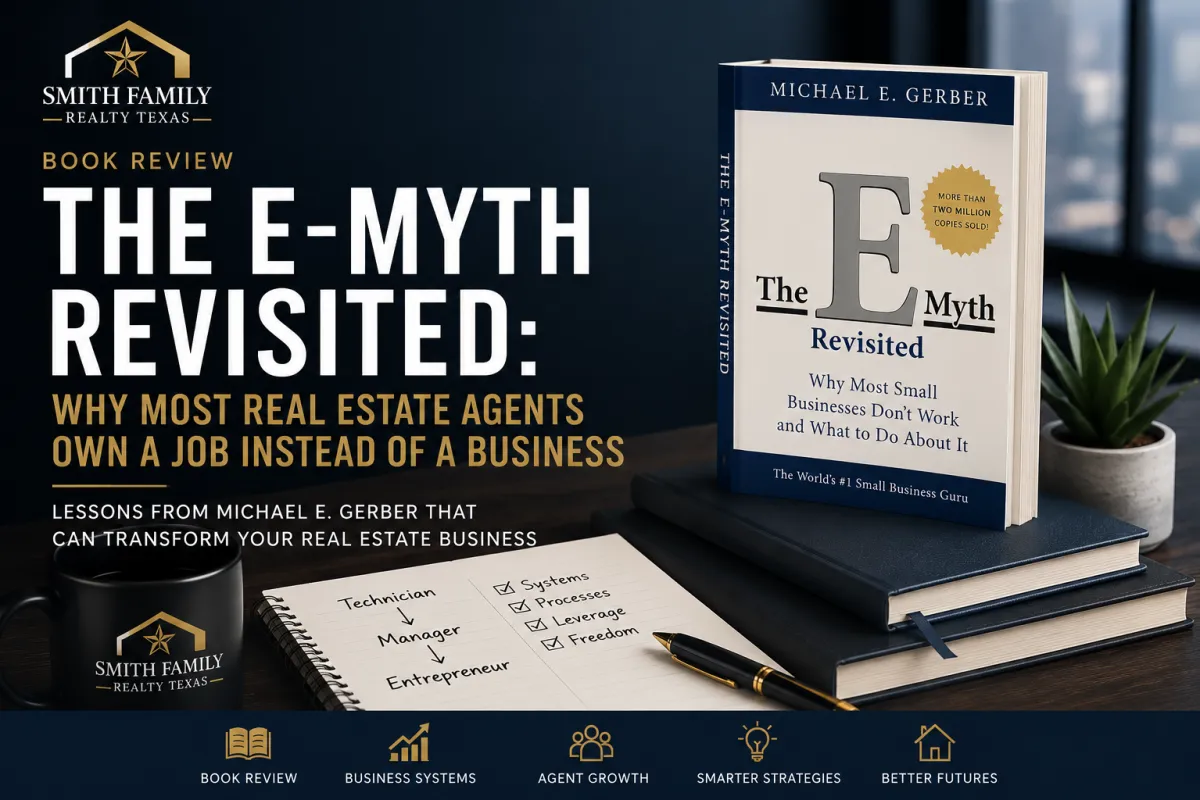
The E-Myth Revisited: Essential for Texas Realtors
Real Estate, Business Growth, Book Review, The E-Myth Revisited
Book Review for Texas Real Estate Pros: “The E-Myth Revisited” by Michael E. Gerber
“The E-Myth Revisited” is not a real estate book, yet it may be one of the most important books a Texas agent, team leader, or broker can read if the goal is sustainable growth. Michael E. Gerber explains why so many small businesses fail—and more importantly, how to build one that actually works. For real estate professionals who feel stuck on the production treadmill, this book offers a clear path from being “just a salesperson” to being a true business owner.
Introduction: Why This Book Matters for Texas Real Estate Agents
Many Texas agents launch their careers with hustle, a license, and a lot of optimism. A few years in, they are busy, but not necessarily profitable. Their phone never stops, their evenings and weekends are full of showings, and the idea of taking a real vacation feels unrealistic. Gerber would say they are trapped working in their business, not on it.
“The E-Myth Revisited” (“E-Myth” stands for the “Entrepreneurial Myth”) explains why being great at the work of real estate—pricing homes, negotiating, showing property—is not the same as building a business that can grow and thrive. For Texas real estate professionals competing in fast-moving markets like Dallas–Fort Worth, Houston, Austin, San Antonio, and beyond, this distinction is critical.
Why This Book Hit Me Personally
When I first got into real estate, I thought success came from working harder than everyone else. More calls. More showings. More hours. If I just outworked every other agent in my Texas market, I assumed everything else would eventually fall into place.
What I eventually learned—and what “The E-Myth Revisited” put into words—is that hard work alone does not create freedom. It creates another job. A demanding one, with a boss who never lets you clock out: you.
One of the reasons I built Smith Family Realty Texas the way I did was because I wanted systems, training, and processes that could scale beyond any one individual agent. I did not want a business that fell apart if one person got sick, took a vacation, or decided to move on. I wanted a business that could serve clients at a high level no matter who was in the room.
Reading “The E-Myth Revisited” reinforced something I have seen repeatedly in this business: agents who build systems eventually outperform agents who rely entirely on effort. The ones who treat their real estate practice like a true business—with playbooks, standards, and structure—tend to last longer, grow faster, and experience far less burnout than the ones who try to win purely by grinding harder every year.
That realization made the book feel deeply personal. It validated the direction we chose for SFRT and challenged me to keep thinking like a builder of businesses, not just a top producer chasing the next deal.
Reading “The E-Myth Revisited” felt less like a casual book recommendation and more like holding up a mirror to my own real estate journey in Texas. I saw myself in the Technician Gerber describes—the agent who prided themselves on outworking everyone, answering every call, and saying “yes” to every showing, even if it meant missing family dinners or canceling weekends away.
One line in particular stopped me cold: “Your business is a reflection of you, not your industry.” I had blamed the market, the brokerage, the interest rates—everything but the fact that I had never truly designed my business with intention. I was reacting, not leading.
📌 Key Takeaway: The moment you realize your business looks chaotic because your approach is chaotic is the moment real change becomes possible.
The first time I tried to take a true vacation, my phone still rang nonstop. Clients texted at all hours, deals nearly fell apart, and I spent more time hiding in hotel hallways taking calls than actually resting. That trip made it painfully clear: I did not own a business—I was the business. If I stopped, everything stopped.
“If your business depends on you, you don’t own a business—you own a job. And it’s the worst job in the world because you’re working for a lunatic.” — Michael E. Gerber
That quote hit me like a freight train. I realized I had built a high-pressure job with no real boundaries, no clear systems, and no path to step back without everything collapsing. From that point on, I stopped asking, “How can I close more deals this year?” and started asking, “How can I build a business that still works when I am not personally in every room?”
The shift was not instant, but it was transformational. I began blocking weekly “CEO time” on my calendar, documenting my listing process, and delegating transaction details I had previously guarded out of habit. Slowly, my schedule became less reactive, my client experience became more consistent, and my stress levels dropped—even as the business grew. That is why this book is more than theory to me; it marked the moment I stopped thinking like a busy agent and started operating like a true business owner.
The Core Idea: Technician, Manager, and Entrepreneur
Gerber divides every small business owner into three personalities living inside one person: the Technician, the Manager, and the Entrepreneur. Understanding these roles is the foundation for transforming a real estate practice into a scalable business.
The Technician loves doing the work. For agents, this is showing homes, writing contracts, hosting open houses, and solving client problems. Most agents start—and stay—here.
The Manager focuses on order and consistency. This is the part of you that creates checklists, sets up your CRM, tracks KPIs, and organizes your calendar and files so nothing falls through the cracks.
The Entrepreneur thinks about vision, strategy, and the future. This is where you design your ideal business model, define your target market in Texas, and plan how to scale beyond your personal production.
Gerber’s argument is simple but powerful: most small businesses fail because the owner is almost entirely a Technician. In real estate, that means you are always in the car, on the phone, or in a showing—but rarely stepping back to design a business that does not depend on you doing everything yourself.

Teams that balance technician work with systems and strategy scale faster and more sustainably.
Key Lesson #1: Systems Outperform Talent Over Time
Gerber emphasizes that systems—not raw talent—create consistent, predictable results. In real estate, you may know incredibly gifted agents who still ride a financial roller coaster because their business is built on effort, not structure. Systems turn occasional excellence into a reliable standard.
Applied to real estate, this means designing and documenting systems for:
Lead generation: Clear weekly targets for conversations, open houses, digital ads, and referral outreach, with scripts and time blocks you follow regardless of how busy you feel.
Lead follow-up: A defined cadence for calls, texts, and emails over the first 30, 60, and 90 days, tracked inside your CRM rather than in your memory or on sticky notes.
CRM usage: Standard fields, tags, and workflows so every contact is handled the same way, whether it is you or an assistant clicking the buttons.
Over time, these systems will outperform even the most charismatic, hard-working solo agent who relies purely on memory and long hours. In a competitive Texas market, consistency is a major advantage.
Key Lesson #2: Build a Business That Works Without You
Gerber challenges owners to build their business as if they were going to franchise it. That does not mean every Texas agent must open multiple offices. It means designing your real estate business so it could, in theory, operate without you personally doing every task.
For real estate, this mindset directly affects:
Listing systems: Standardized pre-listing packets, pricing strategies, marketing plans, and communication timelines that any trained team member can follow with your oversight, not your constant presence.
Buyer consultations: A repeatable presentation, needs-analysis form, and follow-up plan so every buyer receives the same high-level experience, regardless of which agent on the team meets them first.
Transaction management: Checklists and timelines for contract-to-close that can be handled by a transaction coordinator or admin, freeing you to focus on relationships and strategy.
When your business can function during your vacation, a family emergency, or while you are at a conference in Austin, you have moved from being a solo Technician to leading an actual business.
Key Lesson #3: Document and Improve Repeatable Processes
Gerber is relentless about documentation. If it is important, it should be written down. This is how you create what he calls a “business development process”—a living manual for how your company operates. In real estate, this is the difference between “I just handle it” and “Here is our documented process for that.”
Start by documenting your listing process from first contact to closing: every email template, every call, every marketing step, every update to the seller.
Do the same for your buyer journey: initial consult, home search criteria, showing standards, offer strategy, and post-closing follow-up.
Then, review these processes regularly with your team, improving them based on feedback, changing Texas contract rules, and market conditions.
Documentation allows you to train new agents faster, maintain quality as you grow, and protect your business from chaos when someone leaves or when volume spikes unexpectedly during a hot market.
Applying E-Myth Principles to Everyday Real Estate Tasks
When you filter your real estate business through Gerber’s lens, every core activity becomes an opportunity to systematize and scale:
Lead generation: Instead of “getting to it when you can,” design a weekly marketing calendar with non-negotiable blocks for prospecting, content creation, and sphere outreach.
Follow-up: Use your CRM to trigger reminders and pre-built sequences, so no lead is left behind, whether they are relocating to Houston in 30 days or retiring to the Hill Country in three years.
CRM management: Standardize tags (buyers, sellers, investors, past clients, vendors), lead stages, and notes, so your database becomes a strategic asset, not just a digital address book.
Team building: Define clear roles—showing agents, listing partners, transaction coordinators—with documented responsibilities, so growth does not equal chaos.
Common Mistakes Gerber Helps Agents Avoid
As you read “The E-Myth Revisited” through a real estate lens, several all-too-familiar mistakes stand out:
Chasing transactions, not building a business: Focusing only on the next closing instead of building a pipeline, a brand, and a client experience that generates repeat and referral business across Texas communities.
Depending on personal effort: Believing that working harder—more calls, more showings, more late nights—will always solve the problem, rather than stepping back to redesign how the business operates.
Not building systems early: Waiting until you are overwhelmed to create processes, instead of building them when your volume is manageable and you have time to think clearly.
Working longer hours instead of smarter hours: Filling every gap in the day with tasks, while neglecting CEO-level work such as planning, hiring, training, and financial review.
📌 Key Takeaway: If your solution to growth is always “work more,” you are operating as a Technician, not as the Entrepreneur your business needs.
SFRT Takeaway: Think Like a Business Owner, Not Just a Salesperson
The core SFRT takeaway from “The E-Myth Revisited” for Texas real estate professionals is straightforward: shift your identity from salesperson to business owner. Sales skills will get you started; business skills will keep you growing and protect you through market shifts, interest-rate changes, and local inventory swings.
Most agents focus on transactions. Better agents focus on relationships. The best agents build systems that consistently generate relationships—so opportunity is never limited to who happens to be in their phone this month.
The goal is not just to close more deals this year. The real goal is to create a business that keeps creating opportunities—new relationships, repeat clients, and referrals—regardless of interest rates, inventory, or headlines about the Texas market.
Thinking like a business owner means you regularly schedule time to:
Review financials, not just commission checks.
Evaluate systems, not just celebrate closings.
Invest in people and tools, not only in personal lead generation.
Gerber’s framework gives you permission—and a blueprint—to step into that owner role with confidence, even if you are currently a solo agent closing 10–20 deals a year.
Ready to Build a Business Instead of Just Working in One?
If you're trying to improve your systems, organize your CRM, create repeatable processes, or scale your business without working more hours, let's talk.
I work with agents every day on lead generation, follow-up systems, business planning, and growth strategies.
Schedule a Strategy Call or reach out directly to start the conversation.
Who Should Read “The E-Myth Revisited” in Real Estate?
New agents: Ideal for those in their first 1–3 years who want to avoid building bad habits and instead design a scalable business from day one.
Experienced agents: Especially those producing solid volume but feeling burned out or stuck around a certain transaction count each year.
Team leaders: Anyone running or launching a team in Texas who needs clarity on roles, standards, and scalable systems for agents and staff.
Brokers and owners: Perfect for brokerage leaders who want to build a culture of systems, training, and predictable client experiences across multiple agents and offices.
Final Ratings for Real Estate Professionals
Category Rating (1–10) Notes Readability 9/10 Clear, story-driven, and accessible even if you dislike “business books.” Practical Application 10/10 Concepts translate directly into systems for lead gen, listings, and teams. Relevance to Real Estate 9/10 Not industry-specific, but highly aligned with the realities of brokerage life. Overall Recommendation 9.5/10 A must-read for any Texas agent serious about building a real business.
One Action You Can Take This Week
Reading is valuable, but implementation grows your business. Choose one core part of your business and build a simple, written system for it this week. A powerful starting point for most Texas agents is:
💡 One Action: Create a documented Lead Follow-Up System inside your CRM. Define exactly what happens in the first 7, 30, and 90 days after a new lead enters your world—what you send, when you call, how you tag them, and how you decide whether they are hot, warm, or nurture. Save your templates, name the workflow, and commit to following it for every new lead for the next 30 days.
This single system will immediately reduce stress, increase conversion, and give you a clear taste of what Gerber promises: a real estate business that runs on well-designed systems, not just on your personal energy. From there, you can apply the same approach to listings, buyers, and team operations—and turn “The E-Myth Revisited” from a great book into a turning point in your Texas real estate career.
Ready to Build a Business Instead of Just Working in One?
If you're trying to improve your systems, organize your CRM, create repeatable processes, or scale your business without working more hours, let's talk.
I work with agents every day on lead generation, follow-up systems, business planning, and growth strategies.
Schedule a Strategy Call or reach out directly to start the conversation.


